

Introduction: The Next Industrial Advantage Is Not Just Automation. It Is Intelligence.
Imagine a manufacturing facility where industrial robots can move between workstations without extensive network rewiring, cameras identify product defects while production is running, and local AI applications analyse machine data without sending every video stream to a remote cloud.
Now imagine extending the same capabilities to warehouses, energy plants, logistics hubs and other industrial environments.
This is the direction in which industrial technology is evolving. Businesses are moving beyond connecting machines to building systems that can interpret information, respond to changing conditions and support better operational decisions.
Three technologies are central to this shift: Private 5G, Edge Computing and Physical AI.
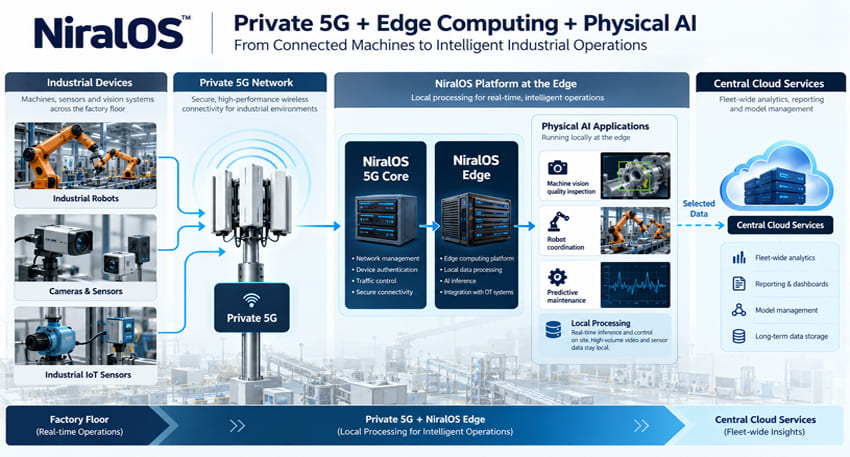
Private 5G provides dedicated wireless connectivity for industrial devices and mobile machines. Edge computing brings processing power closer to the operations generating the data. Physical AI enables intelligent machines to perceive their surroundings, interpret information and perform tasks in the physical world.
Together, these technologies can create a foundation for more flexible and intelligent industrial operations.
For enterprises, however, the challenge is not simply adopting the latest technology. It is integrating connectivity, computing and AI into existing industrial environments without introducing unnecessary complexity, compromising security or disrupting production.
At Niral Networks, we approach this challenge through the convergence of private 5G, edge infrastructure and AI-ready computing platforms. Our focus is to help enterprises establish a practical technology foundation for industrial automation and the next generation of intelligent operations.
Why Industrial Connectivity Is Becoming an AI Infrastructure Decision
Industrial connectivity was traditionally viewed as a way to move information between machines, controllers and enterprise applications. Today, it has a broader role.
AI-enabled applications increasingly rely on data from cameras, sensors, robots and connected equipment. These applications need suitable connectivity, computing resources and integration with operational systems to deliver value.
Consider an industrial robot performing a repetitive task on a production line. If the factory layout changes, the robot’s connectivity and surrounding infrastructure must continue supporting the intended workflow. If an inspection camera generates high volumes of video, the organisation needs sufficient bandwidth and computing capacity to process that information. If a machine-monitoring application detects an anomaly, the resulting alert must reach the appropriate operator or system.
These requirements make connectivity part of the broader AI architecture.
Recent market research supports this direction. In September 2026, Analysys Mason reported that nearly one in five publicly announced private LTE/5G networks in the first half of 2026 explicitly included edge computing. This was the highest proportion recorded by its tracker since 2020. The firm also observed that private-network announcements had declined from their 2023 peak, suggesting that the market’s development should be assessed through application value and deployment maturity, not network counts alone.
The implication for enterprises is straightforward: deploying a private network is only one part of the decision. Businesses must also determine which applications will use it, where their data will be processed and how the complete system will improve operations.
Private 5G: Connecting Machines Across Dynamic Industrial Environments
Private 5G is a dedicated mobile network deployed for an enterprise, industrial facility or campus. It enables organisations to configure connectivity around their operational requirements and supported devices.
In manufacturing, logistics and other industrial environments, private 5G can connect:
- Industrial robots and robotic workstations.
- Automated guided vehicles and autonomous mobile robots.
- Machine-vision cameras and inspection systems.
- Sensors, handheld terminals and connected tools.
- Mobile inspection equipment and industrial IoT devices.
One important advantage is mobility. In environments where equipment moves frequently or production layouts change, wireless connectivity can reduce the need for extensive physical cabling to every connected endpoint.
Private 5G can also support managed traffic policies, device authentication and integration with edge applications. The specific capabilities depend on the network architecture, supported equipment, spectrum and configuration.
This does not mean that private 5G should replace every wired or Wi-Fi connection. Wired Ethernet remains important for many fixed and time-sensitive systems, while Wi-Fi continues to suit numerous enterprise applications. The right approach may combine all three.
The business case for private 5G is strongest when mobility, coverage, device density, operational flexibility or managed connectivity solves a clearly defined problem.
Beyond connectivity: The importance of industrial communication
Industrial automation introduces requirements that go beyond average data speed.
Some applications need predictable communication timing, low jitter, precise synchronisation or high availability. These characteristics matter when machines exchange time-sensitive information.
Time-Sensitive Networking (TSN) addresses specific timing and traffic-management requirements in Ethernet-based environments. 3GPP’s 5G specifications include mechanisms for integrating 5G systems with TSN architectures, allowing suitable wireless connectivity to participate in broader industrial communication designs.
In October 2026, we published technical material on NiralOS TSN and 5G integration, covering industrial communication architecture, synchronisation, traffic handling and deployment considerations.
Read the NiralOS TSN and 5G technical overview.
This is an important distinction: industrial-grade performance comes from engineering the complete system, not simply selecting a 5G network.
5G edge compute: Bringing Intelligence Closer to the Point of Action
As industrial environments become more data-intensive, sending every sensor reading and video stream to a distant cloud can create unnecessary traffic and dependencies. This is where 5G edge compute becomes relevant.
It combines 5G connectivity with computing resources located near the connected devices and applications. Instead of transferring all operational data to a central facility for processing, enterprises can run selected workloads locally.
Consider a quality-inspection system on a production line. Cameras capture images of manufactured components. An AI model hosted on a local edge server analyses the images and identifies potential defects. The application then sends the results to the appropriate inspection or production system. The original video does not necessarily need to leave the facility for every inference request.
This architecture can offer several advantages:
1. Lower potential response times: Processing data locally can reduce the network distance between an application and its data source. Actual response times depend on the complete application and network path.
2. Reduced backhaul traffic: Processing or filtering data at the edge can reduce the volume of information transferred to central systems.
3. Local operational continuity: Selected applications may continue functioning during an external connectivity interruption if their required resources and dependencies are available locally.
4. Greater control over data: Enterprises can keep specified operational information within their controlled infrastructure, subject to their security and governance design.
5. Flexible AI deployment: Organisations can place suitable inference workloads near the equipment they serve, while using central cloud resources for other activities.
The objective is not to move every workload to the edge. It is to decide where each workload should run according to its performance, security, cost and availability requirements.
5G MEC and the Role of an Edge Data Center
Private 5G provides the connectivity layer. Multi-access Edge Computing, or 5G MEC, brings application computing closer to the network’s users and devices. In an industrial deployment, the private 5G network can connect cameras, robots and sensors to applications hosted on nearby edge infrastructure. Those applications may include AI inference, video analytics, device monitoring and operational dashboards.
An Edge Data Center provides the computing, storage and networking resources required to host such workloads. Depending on the scale of the deployment, it may consist of a compact server installation on a factory floor, a dedicated on-site facility or infrastructure serving multiple industrial locations. The distinction between network and computing infrastructure is important. A private 5G network does not automatically provide the servers needed to run AI applications. Similarly, an edge server cannot deliver the intended benefits unless it is integrated with the devices, network and software that use it.
For enterprises, 5G MEC provides a way to design connectivity and computing as complementary components.
What does this mean for Physical AI?
Physical AI applications often combine data from cameras, sensors and other devices with models that interpret the surrounding environment.
A robotic inspection application, for example, may need to analyse visual information, identify a condition and provide a result to a supervisory system. Local edge computing can host the required model and supporting software close to the inspection area. However, not every AI workload should directly control a machine. Safety-critical functions must remain within appropriately engineered and validated control systems.
The architecture should define which decisions AI can make, which require operator approval and which must be handled by established safety mechanisms.
Physical AI: Moving from Data Analysis to Real-World Action
Physical AI refers to AI systems that interact with the physical world through robots, autonomous machines, vehicles and other intelligent equipment. Traditional enterprise AI may analyse documents, summarise reports or answer questions. Physical AI extends intelligence into environments where systems must interpret physical conditions and operate within defined constraints.
Examples include:
- Robots identifying and handling components.
- Vision systems inspecting manufactured products.
- Mobile robots navigating warehouse environments.
- Automated inspection systems collecting information from industrial facilities.
- AI applications detecting abnormal machine behaviour.
- Robotic systems adapting to changes in their surroundings.
These applications depend on more than the AI model itself. They require sensors, suitable data, computing resources, connectivity, software integration and carefully designed operational controls.
The 5G AI connection
The relationship between 5G AI and Physical AI is best understood as a combination of complementary capabilities. AI can interpret data and generate predictions or decisions. Private 5G can provide connectivity for distributed and mobile devices. Edge computing can host the applications that need to process data close to where it is generated. Together, they can support intelligent inspection, robotics and operational analytics.
For example, a mobile robot may use onboard processing for essential navigation and safety functions, while private 5G supports communication with fleet-management applications. An edge server may coordinate operational information from multiple robots, while central infrastructure handles reporting and longer-term analysis.
This distributed approach can make industrial AI applications more practical to deploy, but it does not remove the need for application testing, system integration or safety validation.
The On-premise Cloud: A Practical Foundation for Industrial AI
Many enterprises are reconsidering where their operational applications and data should reside. Public cloud remains valuable for central analytics, model training, enterprise reporting and services shared across multiple locations. However, some industrial applications benefit from being hosted closer to the equipment and data they depend on.
An On-premise Cloud, also known as an On-prem Cloud, provides computing, storage and application services within an organisation’s premises or controlled infrastructure. It can offer cloud-like management capabilities while giving enterprises greater control over workload placement and local computing resources.
For industrial AI, an On-prem Cloud can support:
- AI inference and machine-vision applications.
- Virtual machines and containerised workloads.
- Local databases and operational dashboards.
- Industrial application integration.
- Data processing and storage within a controlled environment.
- Computing services for multiple workloads at an industrial site.
The combination of an On-prem Cloud and an Edge Data Center allows organisations to host selected applications locally while retaining access to central cloud resources.
Why a hybrid architecture makes sense
Consider a manufacturer operating several factories.
Each factory may need local machine-vision processing, operational monitoring and selected applications that remain available even when external connectivity is interrupted. At the same time, the enterprise may want to consolidate performance reports, compare production trends and manage AI models across all its sites.
A hybrid architecture can support both requirements.
Local infrastructure processes operational data where necessary. Central systems provide broader analytics, model development and cross-site visibility. Local hosting does not automatically guarantee cybersecurity, privacy compliance or uninterrupted operations. Enterprises still need appropriate access controls, network segmentation, patching, backups, monitoring and recovery procedures.
The goal is to choose the right location for each workload rather than assuming that every application belongs in one central cloud.
From Connected Machines to Intelligent Operations: Three Practical Use Cases
USE CASE 1: INDUSTRIAL ROBOTICS AND FLEXIBLE MANUFACTURING
Manufacturing facilities often contain multiple robots, inspection cameras and production systems. Changing product designs or production layouts can require substantial engineering effort, particularly where connectivity depends on extensive cabling.
Private 5G can provide wireless connectivity for suitable mobile or reconfigurable equipment. Edge computing can host inspection applications, and Physical AI can help identify components or interpret visual information.
A practical implementation might involve connecting selected robotic workstations over private 5G, hosting a vision model on local edge infrastructure and integrating inspection results with the production system. The intended benefits may include more flexible equipment placement, less dependence on physical connectivity changes and better access to inspection data.
Niral Networks has published industrial robotics material developed in connection with FANUC India, including a proof-of-concept demonstration. Its published webinar materials report approximately 5.6 ms end-to-end latency, throughput above 700 Mbps and 100% network uptime during an eight-hour stress test. These are vendor-reported results from a specific test, not guaranteed performance figures for every deployment.
For enterprises, the relevant next step is to evaluate the same type of architecture against their own robot interfaces, production conditions and acceptance criteria.
USE CASE 2: WAREHOUSING AND INTELLIGENT LOGISTICS
Warehouses combine people, mobile equipment, inventory systems and changing operational demands.
Private 5G can support connectivity for selected AGVs, AMRs, handheld terminals and cameras. Edge computing can process operational information, while AI applications can help identify objects, analyse traffic patterns and coordinate material movement.
A warehouse might use local computing to analyse information from its mobile robot fleet and provide a common operational view to its fleet-management system.
The value should be measured through indicators such as material-handling throughput, task completion times, connectivity performance and operational interruptions. Robot collision avoidance, emergency stops and other safety functions must remain appropriately engineered. AI and wireless connectivity should support these systems, not substitute for required safety mechanisms.
USE CASE 3: PREDICTIVE MAINTENANCE AND INDUSTRIAL INSPECTION
Unplanned equipment downtime can disrupt production and increase maintenance costs. Sensors can capture vibration, temperature, pressure and other operating measurements. A private network can transport selected data, while edge applications analyse it for abnormal patterns.
AI can help identify changes that deserve investigation. Maintenance teams can use the results to prioritise inspections and plan interventions. For example, a monitoring application may identify an unusual vibration pattern in a motor. Rather than treating the output as proof of imminent failure, the system flags the anomaly for further assessment.
This distinction matters. AI-based monitoring can improve visibility, but reliable predictive maintenance depends on suitable sensors, representative data, model validation and integration with maintenance workflows.
How Niral Networks Helps Enterprises Build This Architecture
The enterprise challenge is rarely solved by purchasing a single component. Connectivity, computing, application hosting and management must work together within the customer’s operational environment.
Niral Networks’ NiralOS portfolio addresses key parts of this infrastructure.
NiralOS 5G Core
NiralOS 5G Core provides the foundation for deploying and managing private 5G network infrastructure. It supports the connectivity layer required by compatible industrial devices and applications. Deployment planning must account for spectrum, radio coverage, device support, traffic requirements and integration with existing networks.
NiralOS Edge
NiralOS Edge is a Type-1 hypervisor and AI-assisted operations platform for on-premises IT and OT environments. According to Niral Networks’ product documentation, it supports virtual machines, containers, network and storage virtualisation, and integration with private 5G and MEC environments. This makes it relevant to enterprises looking to host industrial applications, AI inference workloads and supporting services on local infrastructure.
NiralOS Controller
NiralOS Controller supports centralised management of network and edge infrastructure. This can help enterprises maintain visibility and manage deployments as they expand across multiple operational locations. The specific capabilities available depend on the deployed configuration and product version.
Why the integrated approach matters
An integrated architecture can help enterprises avoid treating connectivity, computing and AI as disconnected projects. Instead, they can begin with a defined business problem, select the appropriate connectivity and computing components, integrate the required application and measure the outcome.
Niral Networks’ role is to help customers evaluate and deploy the infrastructure needed for their intended use cases, with technical requirements and expected outcomes established before implementation.
A Practical Roadmap: From Pilot to Production
A successful deployment should begin with a measurable operational requirement, not a technology demonstration alone.
- Step 1: Identify the business problem. Define the challenge, such as quality inspection, robot mobility, equipment monitoring or material handling.
- Step 2: Assess the existing environment. Review devices, radio conditions, wired networks, application dependencies, data flows and security requirements.
- Step 3: Define performance requirements. Specify acceptable response times, availability, throughput, data retention and application accuracy. Do not assume that the network alone determines end-to-end performance.
- Step 4: Design the architecture. Decide where the private 5G network, edge applications, AI models and operational systems will run. Define how they interact with central cloud services.
- Step 5: Run a representative pilot. Test the solution under realistic operating conditions, including failures, network interruptions and changing workloads.
- Step 6: Measure the results. Compare performance against the baseline using agreed metrics such as downtime, inspection accuracy, response times, task completion or reconfiguration effort.
- Step 7: Establish a repeatable deployment model. Document the validated configuration, operational responsibilities, security controls and recovery procedures before expanding to additional sites.
This process allows enterprises to establish evidence of business value before making larger infrastructure commitments.
What Should Enterprises Expect Beyond October 2026?
The convergence of private 5G, edge computing and AI is creating opportunities, but adoption will depend on practical business outcomes.
Analysys Mason’s April 2026 outlook projected worldwide private-network spending to increase from below US$3 billion in 2025 to US$7.5 billion in 2030, while remaining a relatively small part of total mobile-network spending. This is a forecast, not a confirmed future outcome, and illustrates both the market opportunity and the importance of realistic expectations.
Three developments are particularly relevant.
First, edge computing will become a more important part of industrial network design. AI workloads create demand for local processing, but the right placement depends on application requirements and economics.
Second, industrial communication requirements will become more sophisticated. TSN integration, synchronisation, traffic management and application-specific performance testing will matter as enterprises evaluate increasingly demanding workloads.
Third, Physical AI will expand the role of infrastructure. As organisations explore intelligent robotics, inspection and autonomous systems, they will need to connect AI models to real equipment while maintaining operational control, security and safety.
For enterprises, the priority should be building infrastructure that can evolve with these requirements, rather than making assumptions about universal performance or immediate full autonomy.
Conclusion: Intelligent Industry Needs More Than Intelligent Machines
The next phase of industrial transformation will not be defined by AI alone. It will depend on how effectively machines connect, how close computing is to operational data, and how intelligently applications interact with the physical environment.
Private 5G can provide managed wireless connectivity. Edge computing can support local processing. 5G MEC can bring applications closer to connected devices. An On-prem Cloud and Edge Data Center can provide infrastructure for locally hosted workloads. Physical AI can use these capabilities to support robotics, inspection, maintenance and other industrial applications.
The opportunity is significant, but the implementation must be grounded in real operational requirements, measurable results and appropriate engineering controls.
At Niral Networks, we believe the practical path forward is to integrate private 5G, edge infrastructure and AI-ready computing around specific industrial outcomes. With NiralOS, enterprises can explore an infrastructure foundation designed to support connected operations today and more advanced industrial AI applications as their needs evolve.
The goal is not simply to connect more machines. It is to build industrial operations where connectivity, computing and intelligence work together to create measurable value.
Ready to explore Private 5G + Edge Computing + Physical AI for your enterprise?
Connect with Niral Networks to discuss your industrial use case, assess the infrastructure requirements and identify a practical path from pilot to production.
Frequently Asked Questions
What is Private 5G + Edge Computing + Physical AI?
It is an industrial architecture that combines dedicated wireless connectivity, local computing and AI systems that interact with the physical world. It can support applications such as industrial robotics, automated inspection, predictive maintenance and intelligent logistics.
How does 5g edge compute support industrial AI?
5g edge compute combines 5G connectivity with computing resources close to connected devices. It allows selected AI workloads to process sensor data and video locally, potentially reducing response times and unnecessary transfers to remote infrastructure.
What is 5G MEC?
5G MEC stands for 5G Multi-access Edge Computing. It enables computing applications and services to run closer to connected devices and users. In industrial settings, it can support local AI inference, video analytics and operational applications.
What is an Edge Data Center?
An Edge Data Center is a computing facility located near the devices or systems generating data. It provides resources such as servers, storage and networking for local applications, analytics and AI workloads.
What is the difference between an On-premise Cloud and a public cloud?
An On-premise Cloud runs computing services on infrastructure within an organisation’s premises or controlled environment. A public cloud uses a cloud provider’s infrastructure. The two can be combined so that local applications process operational data while central cloud resources support model training, reporting and broader analytics.
How does 5G AI differ from Physical AI?
5G AI is a broad term for AI applications and capabilities associated with 5G networks and connected environments. Physical AI specifically describes AI systems that perceive and interact with the physical world through robots, machines or other equipment. The two can work together when AI-enabled devices use private 5G connectivity and edge computing.
Is Private 5G always better than Wi-Fi for industrial automation?
No. Private 5G can be suitable for mobile equipment, broad-area coverage and managed connectivity across industrial environments. Wi-Fi and wired Ethernet remain useful for many applications. Enterprises should compare the technologies against their coverage, mobility, performance, security, integration and cost requirements.
Can Physical AI run without an internet connection?
Some applications can perform selected tasks locally if the necessary models, computing resources and supporting services are available on-site. Other applications depend on remote services. Local operation and failure behaviour must be validated for the particular use case.
How does Niral Networks support Private 5G and Edge AI deployments?
Niral Networks provides private 5G and edge infrastructure through its NiralOS portfolio, including NiralOS 5G Core, NiralOS Edge and NiralOS Controller. These components can form part of an enterprise architecture for connectivity, local application hosting and infrastructure management.
