
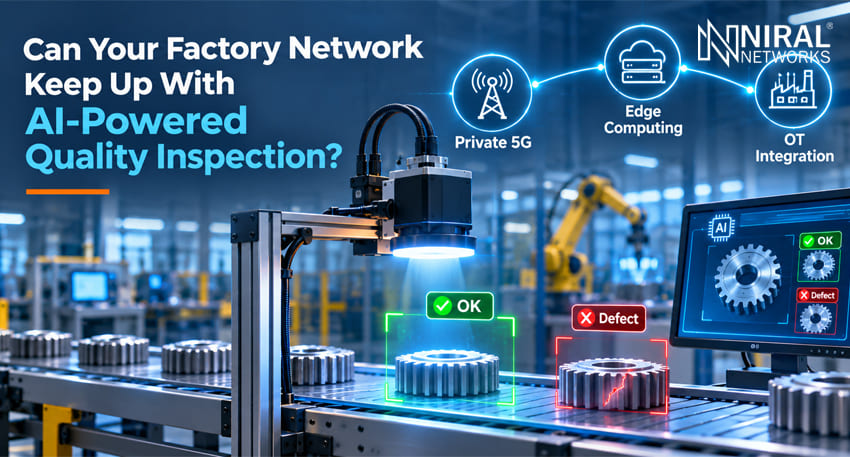
Can Your Factory Network Keep Up With AI-Powered Quality Inspection?
Why industrial machine vision needs more than high-resolution cameras – the role of Private 5G, Edge Computing and reliable industrial connectivity.
A manufacturing defect may be small, but the cost of missing it can be significant. A component that passes inspection unnoticed can move further down the production line, affect subsequent processes and eventually reach the customer.
This is one reason manufacturers are increasingly exploring AI-powered quality inspection. By combining industrial cameras, machine vision and AI models, production teams can identify visual defects, classify products and detect patterns that may be difficult to identify through conventional inspection alone.
But there is an important question that often receives less attention:
Can the factory’s network and computing infrastructure handle the demands of AI-powered inspection at production scale?
Installing high-resolution cameras and deploying an AI model is only part of the solution. Inspection systems also depend on reliable data transmission, sufficient processing capacity, predictable response times, secure connectivity and integration with production systems.
Cisco and Cognex’s 2026 white paper on AI-driven machine vision identifies infrastructure readiness, bandwidth management, time synchronisation, edge-compute utilisation and data security as important challenges when scaling AI vision across industrial environments.
The implication for manufacturers is clear: successful AI inspection requires more than an accurate model. It requires an industrial infrastructure designed to move, process and act on data reliably.
This is where Private 5G, Edge Computing and industrial networking can play an important role.
The changing role of quality inspection
For years, manufacturers have relied on manual inspection, conventional machine vision and predefined quality checks to identify defects.
These approaches continue to play an important role. However, as products become more complex and production lines become more automated, manufacturers are exploring AI-based inspection to handle a wider range of quality requirements. The difference lies in how inspection systems interpret visual information.
Conventional machine vision typically uses predefined rules, image-processing techniques and programmed parameters to identify specific characteristics. For example, a system may check whether a component is the correct size, whether a label is present or whether a product is positioned correctly. AI-powered machine vision uses trained models to recognise patterns and classify visual information. Depending on the model and application, it can identify surface defects, irregularities, variations in product appearance and other characteristics that may be difficult to capture using fixed inspection rules.
Common applications include:
- Surface inspection for scratches, cracks and irregularities.
- Identifying missing or incorrectly positioned components.
- Checking product dimensions and assembly quality.
- Reading labels, markings and product codes.
- Detecting variations in colour, texture and appearance.
- Classifying products based on visual characteristics.
For manufacturers, the objective is not simply to capture more images. It is to turn visual information into useful quality insights that can support production decisions. However, this also introduces new requirements for data processing, connectivity and computing infrastructure.
Why AI-powered inspection creates infrastructure challenges
Consider a manufacturing facility with several production lines, each using multiple high-resolution cameras to inspect products.
Every camera generates image or video data. AI applications must process this information, identify relevant characteristics and return results to the inspection or production system. As the number of cameras and inspection points increases, the supporting infrastructure becomes more demanding.
There are five important challenges.
A. Increasing data volumes
High-resolution cameras capture detailed images that help AI models identify smaller defects and variations. However, higher image resolution, frame rates and the number of cameras can increase the volume of data moving through the network.
If several inspection stations transmit data simultaneously, the network must have sufficient capacity to handle the combined traffic. Manufacturers therefore need to consider more than the bandwidth required by an individual camera. They must evaluate the total traffic generated across the production environment.
B. Processing capacity
AI-powered inspection requires computing resources to process images and run inference models.
The processing requirements depend on several factors:
- Image resolution and frame rate.
- Complexity and size of the AI model.
- Number of simultaneous inspection streams.
- Required inspection frequency.
- Available CPU, GPU and memory resources.
A system that performs well with one camera may not deliver the same performance when deployed across several production lines. Compute capacity must therefore be planned around the expected operational workload.
C. Response time and predictability
In automated production, inspection results may need to reach a control or production system within a defined time window. For example, an inspection application may need to identify a defective component before it moves to the next stage.
The complete response time includes more than AI inference. It can involve image capture, data transmission, image processing, model execution, communication with the production system and the resulting action. A high-performing AI model cannot compensate for delays elsewhere in the process.
Manufacturers should measure end-to-end response time under realistic production conditions rather than relying only on advertised network or processor specifications.
D. Network reliability
Production environments cannot always accommodate interruptions in connectivity. If an inspection system loses access to its processing platform, the consequences may include delayed inspection results, incomplete data or interruptions to the production workflow.
The network architecture should therefore account for coverage, congestion, redundancy, equipment failures and recovery procedures.
D. Data security
Inspection images may contain sensitive information about product designs, manufacturing processes and production operations. Manufacturers need to establish where this data is transmitted, processed and stored.
Network segmentation, access controls, secure device authentication and appropriate data governance are important considerations when connecting cameras, edge servers and production systems.
Cisco’s 2026 State of Industrial AI research identifies network readiness, cybersecurity and IT/OT collaboration as significant factors influencing the ability to scale industrial AI. Its research surveyed more than 1,000 operational technology decision-makers across 19 countries and 21 industrial sectors.
The message is clear: AI inspection needs an infrastructure strategy, not just an AI deployment strategy.
Why Edge Computing matters for AI-powered inspection
One way to address the growing processing and connectivity requirements of industrial inspection is to bring computing resources closer to the production environment. This is the role of Edge Computing.
Instead of sending every image to a centralised cloud platform, manufacturers can deploy local computing infrastructure within or close to the factory. Selected AI models and applications can then process image data locally.
An illustrative inspection workflow could look like this:
- Industrial cameras capture images of products moving along a production line.
- Image data is transmitted to a local edge server.
- An AI model hosted on the edge infrastructure analyses the images.
- The application generates an inspection result.
- The result is shared with the relevant production or quality-management system.
- Selected inspection records are stored or forwarded to central platforms for reporting and analysis.
This architecture can offer several advantages.
- Local AI inference AI models can run on edge servers equipped with suitable processing resources. This allows selected inspection workloads to be processed closer to where the data originates.
- Reduced dependence on distant cloud processing Applications that require local processing do not need to send every image to a remote cloud platform. This can reduce unnecessary data transfers and connectivity dependencies.
- Shared computing infrastructure Multiple inspection applications may use a common edge environment, subject to available processing capacity and workload requirements.
- Greater control over operational data Manufacturers can design local processing and storage arrangements that align with their data-security and operational requirements.
- Flexible application deployment Edge platforms that support virtualisation and containerisation can provide a common environment for deploying, managing and updating different industrial applications.
However, edge computing is not automatically the right choice for every workload. Manufacturers must consider hardware availability, application compatibility, network performance, redundancy and maintenance requirements.
The objective is to place each workload where it can be processed most effectively.
Where Private 5G fits into the architecture
Edge Computing addresses the processing side of AI inspection. But the cameras, robots, sensors and edge infrastructure still need to communicate. This is where Private 5G can become relevant.
A Private 5G network provides dedicated wireless connectivity within an enterprise environment. It can support compatible devices and applications that need to communicate across production areas, warehouses and other industrial spaces. For AI-powered quality inspection, Private 5G can support several use cases.
Edge computing: Processing closer to the operation
Connecting mobile inspection systems
Some inspection applications use mobile robots or automated platforms to examine different production areas. Private 5G can provide wireless connectivity as these systems move across a facility, subject to appropriate radio coverage and device compatibility.
Supporting flexible production environments
Manufacturing layouts change as production lines are reconfigured, equipment is relocated or new inspection stations are introduced.
Wireless connectivity can provide flexibility for compatible devices without requiring a new physical network connection at every location.
Connecting cameras, sensors and edge infrastructure
A suitably designed Private 5G network can connect compatible cameras, sensors, mobile systems and other industrial devices to applications hosted on local edge infrastructure.
Supporting local data processing
With appropriate network architecture and local user-plane deployment, data can be routed towards applications within the enterprise environment. This can help reduce unnecessary traffic through distant network locations.
What about fixed industrial cameras?
An important point: Private 5G does not need to replace every wired industrial connection.
For fixed cameras generating continuous high-resolution image streams, industrial Ethernet may remain the more suitable option, depending on bandwidth, synchronisation and determinism requirements.
Private 5G can complement wired infrastructure, particularly where mobility, flexible layouts or wireless connectivity provide operational value.
A practical factory architecture may therefore combine:
- Industrial Ethernet for fixed, high-throughput inspection stations.
- Private 5G for compatible mobile inspection systems and wireless devices.
- Edge Computing for local AI inference and application hosting.
- Centralised cloud platforms for reporting, analytics and model development.
The choice should be based on the actual requirements of each application, rather than assuming that one connectivity technology can serve every industrial need.
Why OT integration is just as important as connectivity
An AI inspection system becomes valuable when its findings can influence production decisions.
Simply identifying a defect is not enough. The result must reach the appropriate operational system, be interpreted correctly and trigger an action where required. This is where Operational Technology (OT) integration becomes important. Consider a production line where an AI application identifies a defective component.
A connected workflow could involve:
- A camera captures the component.
- An edge-hosted AI model analyses the image.
- The application generates a quality classification.
- The inspection result is communicated to the relevant production system.
- The quality-management application records the result.
- An authorised control process determines whether the component should be rejected, diverted or reviewed.
Depending on the manufacturing environment, this integration may involve:
- Programmable Logic Controllers (PLCs).
- Manufacturing Execution Systems (MES).
- Supervisory Control and Data Acquisition (SCADA) systems.
- Quality Management Systems (QMS).
- Industrial IoT platforms.
- Enterprise Resource Planning (ERP) systems.
The architecture must define how inspection results are exchanged, how timestamps and product identifiers are maintained, and how exceptions are handled. It should also distinguish between an AI-generated recommendation and an authorised machine-control action.
For safety-critical operations, established control and safety systems must retain their validated responsibilities. An AI inspection application or wireless network should not be treated as a replacement for safety-rated control mechanisms.
The real value of industrial AI emerges when inspection insights become part of the production workflow, not when they remain isolated in a dashboard.
What should manufacturers evaluate before deployment?
Before investing in AI-powered inspection, manufacturers should assess the complete infrastructure supporting the application.
The following checklist provides a practical starting point.
Evaluation area | Questions manufacturers should ask |
Camera requirements | What resolution, frame rate and image quality does the application require? |
Network capacity | Can the network handle the combined data traffic from all inspection stations? |
Response time | What is the acceptable end-to-end time between image capture and inspection result? |
Edge infrastructure | Are sufficient CPU, GPU, memory and storage resources available? |
AI model requirements | Is the model compatible with the selected hardware and deployment environment? |
Connectivity | Should the application use Ethernet, Private 5G, Wi-Fi or a combination? |
OT integration | How will inspection results connect with PLCs, MES, SCADA and QMS platforms? |
Cybersecurity | Are devices authenticated, networks segmented and access permissions controlled? |
Reliability | What happens if a camera, network connection, server or AI application becomes unavailable? |
Scalability | Can the architecture accommodate additional cameras, production lines and facilities? |
Start with a pilot, then measure performance
Rather than deploying AI inspection across an entire factory immediately, manufacturers can begin with a controlled pilot.
A pilot should establish a baseline and measure:
- Inspection accuracy against a verified reference dataset.
- False-positive and false-negative rates.
- End-to-end response time.
- Network utilisation and packet loss.
- Edge server resource consumption.
- System availability and recovery behaviour.
- Integration performance with existing production systems.
This helps organisations identify infrastructure constraints before expanding the deployment.
It also ensures that business decisions are based on measured operational results rather than assumptions about AI or network performance.
How Niral Networks supports the infrastructure for industrial AI
Building an AI-ready manufacturing environment requires connectivity, computing and infrastructure management to work together.
Niral Networks addresses these infrastructure requirements through its NiralOS portfolio, bringing together Private 5G networking, Edge Computing and centralised management.
NiralOS 5G Core: Private 5G network infrastructure
NiralOS 5G Core is a cloud-native software solution designed for enterprise Private 5G deployments. It includes core network functions for mobility management, authentication, session management and policy control, alongside user-plane capabilities. For manufacturing environments, this provides a network foundation for connecting compatible industrial devices and applications through a dedicated private network.
Its local user-plane deployment options can also support traffic routing towards enterprise edge applications, depending on the network architecture.
NiralOS Edge: Local computing and application hosting
NiralOS Edge provides infrastructure for hosting applications on local edge servers. Its published capabilities include virtualisation, containerisation, resource monitoring, configuration, provisioning and application lifecycle management.
For AI-powered inspection environments, this can provide a platform for hosting suitable third-party applications, including AI/ML and video analytics workloads, subject to the available hardware and application requirements. It also supports integration with different connectivity technologies, including 5G, Wi-Fi and Ethernet. This is relevant for manufacturers operating mixed-connectivity environments.
Explore: NiralOS Edge.
NiralOS Controller: Centralised infrastructure management
As industrial deployments expand, managing network and edge infrastructure across different production areas or facilities can become more complex. NiralOS Controller provides centralised orchestration and management capabilities for Private 5G and Edge infrastructure. Its role is to support provisioning, monitoring and management through a unified platform, helping enterprises manage distributed infrastructure environments.
Explore: NiralOS Products.
Bringing the infrastructure together
Infrastructure component | NiralOS solution | Its role |
Private connectivity | NiralOS 5G Core | Provides Private 5G network infrastructure |
Local computing | NiralOS Edge | Hosts suitable industrial and AI applications |
Infrastructure management | NiralOS Controller | Supports centralised provisioning, orchestration and monitoring |
Together, these components provide an infrastructure foundation for enterprises exploring connected manufacturing, machine vision and industrial AI. The AI inspection application, cameras, industrial control systems and their integration would still need to be selected, configured and validated according to the factory’s requirements.
Niral Networks’ role is to help address the connectivity and computing infrastructure that supports these applications.
AI-powered quality inspection needs an AI-ready factory network
AI-powered quality inspection can help manufacturers improve how they identify defects, monitor product quality and respond to production variations. But scaling these applications requires more than sophisticated cameras or accurate AI models.
It requires networks that can handle growing data volumes, computing resources that can process information efficiently, and integration that connects inspection results with real production workflows.
Private 5G can provide wireless connectivity where mobility and flexible deployment matter. Edge Computing can support local AI inference and application hosting. Industrial Ethernet and other established technologies continue to serve important roles where fixed, predictable and high-throughput connections are required. The most effective architecture is not necessarily built around a single technology. It is built around the requirements of the inspection application and the wider manufacturing operation.
Because an intelligent inspection system is only as effective as the infrastructure that supports it.
Build an infrastructure ready for industrial AI
Are you evaluating AI-powered quality inspection, machine vision or connected manufacturing applications?
Explore how Niral Networks can help you bring Private 5G, Edge Computing and infrastructure management together for your industrial operations.
Frequently Asked Questions
What is AI-powered quality inspection in manufacturing?
AI-powered quality inspection uses artificial intelligence and machine vision to analyse images of manufactured products and identify defects, irregularities or variations. It can support applications such as surface inspection, component verification, product classification and assembly checks.
Why does AI-powered inspection need reliable industrial connectivity?
AI inspection systems often process images and video generated by multiple cameras. Reliable connectivity helps transfer this information to processing systems and deliver inspection results to production applications. Network performance should be evaluated against the application’s bandwidth, response-time and availability requirements.
How does Edge Computing improve AI-powered quality inspection?
Edge Computing allows suitable AI models and applications to run on computing infrastructure located close to production operations. This can reduce dependence on distant cloud processing, support local data handling and provide shared computing resources for multiple inspection applications.
Can Private 5G connect industrial cameras?
Yes, compatible industrial cameras and gateways can connect through Private 5G. Its suitability depends on camera interfaces, bandwidth requirements, radio coverage and application performance. Fixed cameras with continuous high-resolution streams may still be better suited to industrial Ethernet.
Does Private 5G replace industrial Ethernet?
No. Private 5G and industrial Ethernet can complement one another. Ethernet remains important for fixed equipment and applications requiring predictable wired connectivity, while Private 5G can provide wireless mobility and deployment flexibility for suitable devices.
What is the role of MEC in AI-powered inspection?
Multi-access Edge Computing (MEC) brings computing resources closer to connected devices and applications. In a manufacturing environment, MEC can host selected AI inference, video analytics and industrial applications locally, subject to available infrastructure and workload requirements.
How can manufacturers connect AI inspection with existing production systems?
Inspection applications can exchange results with systems such as PLCs, MES, SCADA and QMS platforms through suitable industrial interfaces and integration layers. The architecture should define data formats, timestamps, product identifiers, control responsibilities and exception-handling processes.
How does NiralOS support industrial AI infrastructure?
NiralOS brings together Private 5G networking through NiralOS 5G Core, local application hosting through NiralOS Edge, and centralised infrastructure management through NiralOS Controller. Together, these components can support the connectivity and computing foundation for suitable industrial AI applications.
