


Can Your Factory Network Keep Up With AI-Powered Quality Inspection?
Why industrial machine vision needs more than high-resolution cameras – the role of Private 5G, Edge Computing and reliable industrial connectivity.
A manufacturing defect may be small, but the cost of missing it can be significant. A component that passes inspection unnoticed can move further down the production line, affect subsequent processes and eventually reach the customer.
This is one reason manufacturers are increasingly exploring AI-powered quality inspection. By combining industrial cameras, machine vision and AI models, production teams can identify visual defects, classify products and detect patterns that may be difficult to identify through conventional inspection alone.
But there is an important question that often receives less attention:
Can the factory’s network and computing infrastructure handle the demands of AI-powered inspection at production scale?
Installing high-resolution cameras and deploying an AI model is only part of the solution. Inspection systems also depend on reliable data transmission, sufficient processing capacity, predictable response times, secure connectivity and integration with production systems.
Cisco and Cognex’s 2026 white paper on AI-driven machine vision identifies infrastructure readiness, bandwidth management, time synchronisation, edge-compute utilisation and data security as important challenges when scaling AI vision across industrial environments.
The implication for manufacturers is clear: successful AI inspection requires more than an accurate model. It requires an industrial infrastructure designed to move, process and act on data reliably.
This is where Private 5G, Edge Computing and industrial networking can play an important role.
The changing role of quality inspection
For years, manufacturers have relied on manual inspection, conventional machine vision and predefined quality checks to identify defects.
These approaches continue to play an important role. However, as products become more complex and production lines become more automated, manufacturers are exploring AI-based inspection to handle a wider range of quality requirements. The difference lies in how inspection systems interpret visual information.
Conventional machine vision typically uses predefined rules, image-processing techniques and programmed parameters to identify specific characteristics. For example, a system may check whether a component is the correct size, whether a label is present or whether a product is positioned correctly. AI-powered machine vision uses trained models to recognise patterns and classify visual information. Depending on the model and application, it can identify surface defects, irregularities, variations in product appearance and other characteristics that may be difficult to capture using fixed inspection rules.
Common applications include:
- Surface inspection for scratches, cracks and irregularities.
- Identifying missing or incorrectly positioned components.
- Checking product dimensions and assembly quality.
- Reading labels, markings and product codes.
- Detecting variations in colour, texture and appearance.
- Classifying products based on visual characteristics.
For manufacturers, the objective is not simply to capture more images. It is to turn visual information into useful quality insights that can support production decisions. However, this also introduces new requirements for data processing, connectivity and computing infrastructure.
1. The hidden computing challenge behind industrial robotics
Industrial robots increasingly rely on AI to interpret information from cameras, LiDAR, proximity sensors and other connected devices. These inputs help robots identify objects, detect changes in their surroundings, inspect products and plan tasks.
However, AI workloads can demand substantial computing resources. Larger models may require more processing power and memory than a compact robot can efficiently accommodate.
Keeping all this computing onboard can introduce several challenges:
- Processing limitations: The robot’s onboard hardware may not have enough capacity to run increasingly sophisticated AI models.
- Power consumption: High-performance processors and GPUs can increase energy requirements, particularly for mobile robots.
- Thermal management: More computing power can mean additional heat, creating hardware and operating constraints.
- Hardware cost: Equipping every robot with high-performance computing can increase the cost of deploying and expanding a fleet.
- Scalability: Upgrading computing hardware across a large number of robots can become complex and expensive.
Microsoft Research examined this challenge in its September 2026 study, Offloaded inference for real-world physical AI robotics. The research explored how distributing AI inference between robots, edge infrastructure and cloud resources could improve performance in representative mobile manipulation workloads. It also highlighted potential benefits for battery life and the ability to run larger models.
Importantly, the researchers identified trade-offs involving network latency, bandwidth and available GPU resources. Offloading is therefore an architectural decision, not a universal solution.
For industrial organisations, the key question is not simply how powerful a robot’s processor should be. It is how computing resources should be distributed across the entire operation.
2. Should AI run onboard, at the edge or in the cloud?
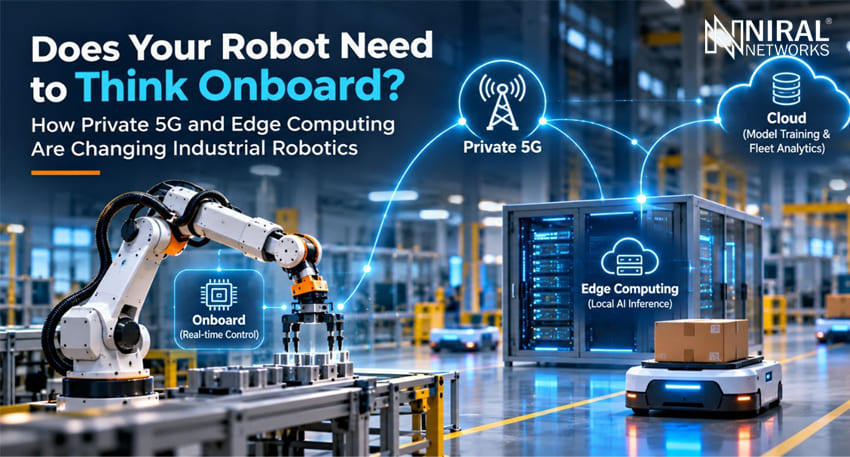
There are three primary locations where industrial AI workloads can be processed: onboard devices, local edge infrastructure and centralised cloud platforms. Each has a different role.
Onboard computing: Processing directly on the robot
Onboard computing means that processing takes place using hardware installed within the robot.
It is particularly important for functions that require immediate local responses, including:
- Motion control and motor coordination.
- Immediate sensor processing.
- Local obstacle detection and protective functions.
- Time-critical actions that must continue even if network connectivity is interrupted.
The main advantage is independence from an external computing connection. The robot can execute essential local functions without waiting for a remote server.
However, onboard resources are limited by the robot’s size, power budget, cooling capacity and hardware configuration. Running every AI application locally may not always be practical.
Edge computing: Processing closer to the operation
Edge computing moves selected computing workloads to servers located within or close to an industrial facility.
Instead of requiring every robot to carry high-performance computing hardware, enterprises can use shared edge infrastructure to run selected AI models and applications.
This can support applications such as:
- AI-powered visual inspection.
- Object recognition and classification.
- Fleet-level coordination.
- Video analytics.
- Processing data from multiple cameras and sensors.
- Selected perception and planning workloads.
An important advantage is the ability to allocate computing resources across multiple applications and devices.
For example, a manufacturing facility may have several robots and inspection cameras connected to a local edge platform. Depending on application requirements, the platform can host selected AI workloads without requiring every device to run the same processing infrastructure independently.
Edge computing can also help organisations keep sensitive operational data within their premises, subject to the deployment architecture and security controls. However, edge processing introduces network dependencies. If a robot needs to communicate with an edge server for a particular inference task, the network must provide suitable coverage, latency, bandwidth and resilience.
Cloud computing: Centralised intelligence and large-scale processing
Cloud platforms provide access to scalable computing resources and centralised data services. They are useful for workloads that do not necessarily need to run close to the robot, including:
- Training and fine-tuning AI models.
- Analysing historical operational data.
- Comparing performance across multiple facilities.
- Long-term data storage and reporting.
- Centralised model management and updates.
- Large-scale simulation and development.
Cloud computing can provide access to substantial computing capacity without requiring enterprises to maintain all the infrastructure themselves.
However, sending every operational request to a distant cloud platform may introduce additional network latency, bandwidth requirements and connectivity dependencies.
A practical comparison
Computing Location | Best suited for | Key consideration |
Onboard | Immediate local processing and essential robot functions | Hardware, power and thermal limits |
Edge | Selected AI inference and applications requiring proximity to operations | Local compute capacity and network performance |
Cloud | Model training, historical analysis and centralised management | Connectivity, data movement and response time |
The most effective architecture is often a combination of all three.
For example, a mobile robot could handle essential movement and safety functions onboard, send selected camera data to a nearby edge server for more demanding AI inference, and share operational information with a central platform for fleet-level analysis.
The exact division depends on the robot, application, network and operational environment.
3. How Private 5G changes the robotics architecture
Distributing AI workloads requires more than computing infrastructure. Robots, cameras, sensors and edge servers must communicate reliably.
This becomes particularly important in industrial environments where devices may move across large areas, operate alongside other machines and generate significant volumes of data. Traditional industrial connectivity options remain valuable. Ethernet, industrial Wi-Fi and fieldbus technologies continue to support many automation requirements. However, as facilities introduce more mobile equipment and connected applications, they may need a combination of connectivity technologies.
Private 5G offers a dedicated wireless networking option for connecting industrial devices and applications within a defined operational environment.
Its potential advantages for robotics include:
1. Mobility across industrial environments
Mobile robots and autonomous mobile robots (AMRs) need connectivity as they move between work areas. Private 5G can support wireless connectivity across a facility, subject to radio planning, coverage and device compatibility.
2. Connectivity for multiple device types
A private 5G network can connect compatible robots, cameras, sensors, gateways and other industrial equipment through a common wireless infrastructure.
3. Local data routing
With an appropriately designed 5G architecture, local user-plane functions can route traffic towards applications and edge infrastructure within the facility. This can reduce the need to send all operational traffic through distant networks.
4. Network management and segmentation
Private 5G architecture can support network slicing and policy-based traffic management. These capabilities can help enterprises design connectivity for different categories of devices and applications.
However, network slicing alone does not guarantee application performance. Radio conditions, device capabilities, core configuration, transport networks and application behaviour all influence end-to-end performance.
Why the complete architecture matters
Consider a warehouse using AMRs to move materials between storage and dispatch areas.
The robots collect information through onboard sensors and cameras. Selected data may be transmitted over Private 5G to a local edge server, where an AI application processes information or supports fleet-level coordination. Relevant operational data can then be shared with warehouse management systems or central analytics platforms.
In this arrangement:
- The robot handles essential local functions.
- Private 5G provides wireless connectivity.
- The edge platform hosts selected AI applications.
- Central systems support wider operational visibility and analysis.
This is an example of how connectivity and computing can work together to support distributed robotics.
It is also important to distinguish AI inference from safety-critical control. Functions such as emergency stopping, protective interlocks and safety-rated motion control must remain within appropriately engineered and validated safety systems. A wireless network or remote AI application should not be assumed to replace them.
4. Network management and segmentation
Multi-access Edge Computing (MEC) brings computing resources closer to the devices and applications that need them.
In a Private 5G environment, MEC can provide a local platform for hosting industrial applications and processing selected data without depending entirely on central cloud infrastructure. For robotics, this creates several possibilities.
Local AI inference
An edge server equipped with suitable CPU, GPU and memory resources can host AI models used for image recognition, inspection, object classification and other workloads. The robot can send selected data to the edge platform for processing and receive the resulting information or recommendations. The feasibility of this approach depends on the size of the model, the volume of data, the network path and the application’s response-time requirements.
Shared computing resources
Instead of installing high-performance computing hardware in every robot, an enterprise may use shared edge servers to support multiple applications and devices.
This can improve infrastructure utilisation, although capacity planning is essential. If too many applications compete for the same resources, processing delays may increase.
Local data processing
Industrial cameras and sensors can generate large volumes of information. Processing selected data locally can reduce unnecessary transfers to central platforms. It can also support applications where operational data needs to remain within a facility for security, privacy or governance reasons.
Application deployment and management
A suitable edge platform can provide virtualisation, containerisation and application lifecycle management. These capabilities help organisations deploy and maintain applications across local infrastructure.
For enterprises operating several facilities, centralised management can also make it easier to maintain visibility of distributed edge environments.
The objective is to create an infrastructure in which computing resources can be deployed according to the needs of individual applications rather than being restricted to the hardware available on each robot.
5. Where distributed AI computing can support industrial robotics
The combination of robotics, Private 5G and edge computing can support several industrial applications. The exact architecture will vary depending on the equipment, environment and level of automation.
Manufacturing: AI-powered inspection and assembly
Robotic arms and machine-vision systems can inspect products, identify visible defects and support precision assembly.
Selected image-processing workloads can run on local edge infrastructure, while robots retain their essential motion and safety functions onboard. This can provide a flexible way to support multiple inspection stations and production lines.
Warehousing: Autonomous mobile robots
AMRs move materials between storage, picking and dispatch areas. Private 5G can provide connectivity across the warehouse, while edge applications can support selected fleet coordination, analytics and operational monitoring workloads.
The design must account for local navigation, obstacle detection and safe stopping independently of remote processing.
Mining: Remote monitoring and robotic inspection
Mining environments can involve large operating areas, challenging conditions and equipment that is difficult to inspect manually.
Connected inspection systems and robotic platforms can collect information from machinery and infrastructure. Edge computing can support local analysis, while Private 5G can provide connectivity where suitable radio coverage has been engineered.
Ports: Connected cargo-handling operations
Ports are exploring connected equipment, automated logistics, smart sensors and real-time monitoring.
In India, Mormugao Port Authority secured authorisation for a Captive Non-Public Network (CNPN) in September 2026. The Government of India announced the development on 15 October 2026, identifying potential applications including automated logistics, cargo tracking, drone-based surveillance and smart sensors. The project was progressing through planning and proof-of-concept activities at the time of the announcement.
This development illustrates growing interest in dedicated connectivity for industrial and logistics environments. It does not, by itself, establish that autonomous robotics is already operational at the port.
Energy: Robotic infrastructure inspection
Robotic inspection systems can help monitor equipment and infrastructure in energy facilities.
Selected sensor and image data can be processed locally, with relevant insights shared with central monitoring platforms. This can support operational visibility while reducing the need to transmit every data stream to a remote environment.
6. What should enterprises consider before deployment?
Moving AI inference between onboard, edge and cloud environments requires careful planning. A successful deployment depends on more than selecting a robot, a 5G network or an edge server.
Here are seven considerations for industrial decision-makers.
1. Understand the workload
Start by identifying what the robot needs to process and how quickly it needs the result. A workload that supports historical analysis has different requirements from one that influences a robot’s immediate response.
2. Evaluate onboard computing capacity
Review the robot’s existing processor, memory, GPU capability, power consumption and thermal limits. Retain essential local functions and identify workloads that could benefit from additional computing resources.
3. Plan the network architecture
Assess radio coverage, bandwidth, latency, jitter, mobility and network resilience across the operating environment. Test performance under realistic conditions, including periods of high network utilisation.
4. Size the edge infrastructure
Estimate the CPU, GPU, memory and storage requirements of the applications. Account for the number of robots, cameras, simultaneous workloads and expected future expansion.
5. Check application compatibility
Confirm that AI models, robotics software, containers, operating systems and interfaces are compatible with the proposed infrastructure. Integration with existing industrial systems is equally important.
6. Address cybersecurity and OT integration
Industrial networks connect operational technology, enterprise systems and increasingly intelligent devices. Organisations should establish access controls, network segmentation, secure device authentication, monitoring and clear data governance policies.
7. Design for resilience and safety
Determine what happens when a robot loses connectivity to an edge server or when an application becomes unavailable. Essential local control and safety functions must continue to operate according to the system’s validated safety design.
These considerations should be evaluated through controlled trials before moving towards wider deployment.
7. How Niral Networks supports distributed industrial AI
For enterprises exploring distributed AI computing, the connectivity and computing layers need to work as an integrated architecture.
Niral Networks addresses these infrastructure requirements through its NiralOS portfolio, which brings together Private 5G, edge computing and centralised infrastructure management.
NiralOS 5G Core: Private network connectivity
NiralOS 5G Core provides the core network software for enterprise Private 5G deployments. Its capabilities include essential 5G network functions, local user-plane deployment options, network slicing and integration with edge infrastructure.
For industrial robotics, this provides the connectivity foundation for compatible robots, cameras, sensors and other connected devices to communicate across an appropriately designed private network.
Learn more: NiralOS 5G Core
NiralOS Edge: Local computing infrastructure
NiralOS Edge provides an edge computing platform with virtualisation and containerisation capabilities for hosting applications on local infrastructure. It can support the deployment of applications such as robotics, AI/ML, IoT and video analytics, subject to the available hardware and application requirements. This provides enterprises with an option to host selected workloads closer to their industrial operations rather than relying entirely on centralised cloud resources.
Learn more: NiralOS Edge
NiralOS Controller: Centralised infrastructure management
Managing connectivity and computing across multiple locations can become complex as deployments expand.
NiralOS Controller supports centralised management, orchestration, provisioning and monitoring of Private 5G network infrastructure and on-premise edge environments. For organisations operating across multiple facilities, this can help simplify infrastructure administration and provide a more consistent management approach.
Learn more: Niral Networks Private 5G Solution
Bringing the components together
The three components address different parts of the architecture:
Infrastructure layer | NiralOS component | Role |
Connectivity | NiralOS 5G Core | Private 5G network infrastructure |
Computing | NiralOS Edge | Local application and edge workload hosting |
Management | NiralOS Controller | Centralised management and orchestration |
Together, they provide an infrastructure foundation for enterprises exploring connected robotics and distributed industrial AI. The final deployment architecture should still be designed around the specific robot platforms, AI applications, network requirements and safety systems involved.
8. The future of industrial robotics is distributed
Industrial robotics is entering a phase where computing architecture will be just as important as the robot itself.
As AI models become more capable, enterprises will need to reconsider how they allocate processing resources. Equipping every robot with the most powerful available hardware may not always be the most efficient approach. Equally, moving every workload to a remote server can introduce unnecessary dependencies.
The better approach is to distribute workloads intelligently. Keep essential functions onboard. Use local edge infrastructure for suitable AI inference and applications that benefit from proximity. Use cloud platforms for large-scale training, analytics and centralised services. Connect these layers through a network architecture designed around actual operational requirements.
Gartner’s September 2026 analysis of the Physical AI Hype Cycle reinforces this broader perspective: the value of Physical AI depends on coordinating robotics, intelligence, data, computing infrastructure and operational safety rather than relying on a single technology breakthrough.
For industrial enterprises, the next step is not simply to make robots smarter. It is to build the connectivity and computing infrastructure that allows intelligent machines to operate effectively, securely and at scale.
Niral Networks brings Private 5G, Edge Computing and infrastructure management together to help enterprises build that foundation.
Explore distributed AI for industrial robotics
Are you evaluating Private 5G, Edge Computing or AI-powered robotics for your industrial operations?
Connect with Niral Networks to explore an architecture aligned with your operational requirements.
Frequently Asked Questions
Does every industrial robot need an onboard GPU?
No. The requirement depends on the robot’s workload, AI models and response-time requirements. Some applications may need onboard GPU processing, while others can use local edge infrastructure for selected inference tasks. Essential local control and safety functions must remain appropriately implemented on the robot or its validated control systems.
What is AI inference offloading in robotics?
AI inference offloading is the process of transferring selected AI processing tasks from a robot’s onboard hardware to another computing resource, such as a nearby edge server or a cloud platform. The robot sends the required data for processing and receives the resulting output.
Can Private 5G support distributed industrial robotics?
Yes. Private 5G can provide wireless connectivity between compatible robots, sensors, cameras and edge infrastructure. Its suitability depends on radio coverage, network configuration, device compatibility, application requirements and end-to-end performance testing.
What is the difference between Edge AI and Cloud AI?
Edge AI processes data on or near the location where it is generated, which can reduce the distance data needs to travel. Cloud AI uses centralised computing infrastructure that can provide scalable resources for model training, analytics and other workloads. Both can be used together.
How does NiralOS Edge support industrial robotics?
NiralOS Edge provides virtualisation and containerisation infrastructure for hosting applications on local edge servers. Niral Networks identifies robotics, IoT and other industrial applications among the workloads that can be hosted on its edge platform. Actual application performance depends on the server configuration, network architecture and software requirements.
Does moving AI inference to the edge always reduce latency?
No. Edge computing can reduce the distance between the application and its computing resources, but actual end-to-end latency depends on network performance, processing time, application design and the path taken by the data. It should be measured under realistic operating conditions.
Is cloud computing still relevant for industrial robotics?
Yes. Cloud platforms remain valuable for AI model training, large-scale analytics, historical data processing, simulation and centralised management. A distributed architecture can use cloud resources alongside onboard and edge computing.
Research sources
The article is based on the following primary and official sources:
- Microsoft Research — 23 September 2026: Offloaded inference for real-world physical AI robotics. Research on distributing robotics inference across onboard, edge and cloud computing.
- Gartner – 30 September 2026: The 2026 Hype Cycle for Physical AI. Analysis of the technologies and operational capabilities required for Physical AI.
- Government of India, Press Information Bureau – 15 October 2026: Mormugao Port secures Private 5G CNPN authorisation. Official update on the proposed private network and potential port applications.
