

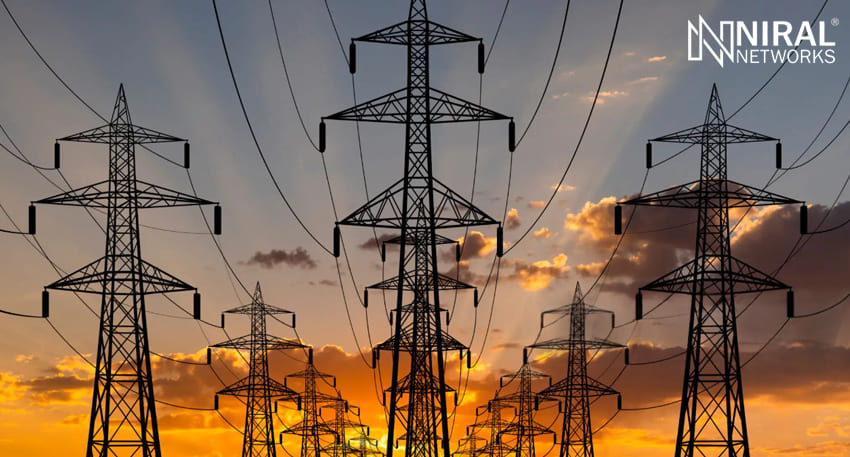
India is entering a new kind of energy challenge. AI, cloud, data centres and electric vehicles are pushing our power grid harder than ever before.
Recent projections show that AI workloads and data centres alone could add around 30 GW to India’s peak power demand over the next 5–6 years. At the same time, the government is preparing for record summer peaks of 270 GW, with more growth expected as electrification and digital infrastructure scale. This is not just a “more megawatts” problem. It is a grid intelligence problem: how do we sense, decide and act fast enough, close enough to where energy is produced and consumed?
That is where edge computing, Edge AI, smart grids and private 5G come together. And this is exactly where Niral Networks is positioning itself as a practical solution provider for Indian utilities, IPPs, and energy‑intensive enterprises.
Why India’s power grid needs intelligence at the edge
India’s data‑centre capacity is expected to grow by about 30% in 2026 alone, adding nearly 500 MW of new supply on top of the 1,700 MW already installed. Much of this new capacity is driven by AI and cloud workloads that run 24×7 and demand extremely reliable power.
At the same time:
- Peak power demand has climbed from around 250 GW in 2024 to a projected 270 GW this summer.
- Government and industry studies warn that AI, data centres and EVs could together push peak demand up by 30 GW or more in the coming years.
- Distribution companies are rapidly rolling out smart meters and digital initiatives like the India Energy Stack to make the grid more data‑driven.
In short, the grid is becoming:
- Heavier – more load, more often.
- More volatile – renewables, EV charging, and data‑centre clusters cause rapid swings.
- More digital – millions of endpoints now talk to the network.
Traditional, centralised control systems struggle in this world. By the time data travels from a substation or feeder to a central control room and back, the situation on the ground may have already changed. That is why global market studies predict that Edge AI in smart grids will grow from around USD 19.5 billion in 2026 to nearly USD 49 billion by 2030, at roughly 25–26% CAGR.
Processing data locally at the grid edge – in substations, feeders, behind‑the‑meter plants, microgrids and industrial campuses – is becoming essential.
What “Edge AI at the grid edge” means in simple words
When we say “Edge AI at the grid edge”, we mean three simple things:
- Collect data locally: Smart meters, sensors, relays, breakers, inverters, transformers and protection devices generate a huge amount of data: voltage, current, frequency, power factor, harmonics, temperature and more.
- Analyse and decide locally: Instead of sending all this raw data to a distant data centre, we deploy edge gateways and servers inside substations, plants and control rooms. AI models and rules run on‑site to detect anomalies, forecast demand or generation, and decide what to do next.
- Act locally in milliseconds: Based on this local intelligence, the system can trip a breaker, adjust a tap changer, ramp an asset up or down, or send precise set‑points to inverters within a few milliseconds, without waiting for the cloud.
Private 5G or other robust connectivity then links these edge sites to each other and to central systems, so operators still get the “big picture”, but critical actions don’t depend on long round‑trips.
Key use cases for edge AI + private 5G in India’s energy sector
1. Real‑time monitoring and automated protection in substations
Substations are the nervous system of the grid. Today, many rely on a mix of legacy protocols and siloed systems that make it hard to see what is happening in real time.
With edge computing and private 5G, utilities can:
- Stream data from protection relays, sensors and smart meters to a NiralOS Edge node in or near the substation.
- Run AI models to detect abnormal patterns such as overloads, voltage flicker, harmonics or suspected faults in real time.
- Trigger automated protection, reconfiguration or alerts within milliseconds, even if upstream networks are congested.
This helps reduce outages, improves power quality and allows a more dynamic use of assets all crucial when the grid is carrying more AI, data‑centre and EV load than ever.
2. Balancing renewables and AI/data‑centre demand
Data centres and AI clusters are often located near major cities like Mumbai, Chennai, Delhi‑NCR and Bengaluru the same regions seeing heavy renewable integration and urban load growth.
Edge AI and private 5G can help by:
- Forecasting local demand and generation using historical data, weather patterns and real‑time signals, processed at the edge.
- Coordinating flexible loads, storage and distributed generation behind the meter – such as batteries, backup generators and rooftop solar – to smooth peaks.
- Enabling behind‑the‑meter “microgrids” for large campuses and AI data centres that can support the grid during stress and island themselves during disturbances.
Analysts note that utilities worldwide are adopting AI‑enabled edge gateways with 4G/5G connectivity to process grid data locally and control assets in real time, instead of relying solely on central SCADA.
3. Predictive maintenance for critical grid assets
Transformers, breakers, cables, switchgear and large rotating machines are expensive and critical. Failures lead to long outages and costly emergency repairs.
With an edge‑native approach:
- Sensors and IoT devices measure vibration, partial discharge, temperature, oil quality and load patterns.
- NiralOS Edge nodes close to the asset run AI‑based condition‑monitoring models to flag early warning signs.
- Maintenance teams receive alerts before a failure, so they can plan shutdowns, order spares and avoid catastrophic events.
Global studies show that utilities using AI‑driven, edge‑based monitoring can cut maintenance costs and outage durations significantly, while improving safety for field crews.
4. Smarter, safer field operations
Line crews and field engineers often work in remote or harsh conditions where traditional connectivity is poor.
Private 5G combined with edge computing can enable:
- AR‑assisted maintenance – technicians wearing AR glasses or using tablets get guided instructions over low‑latency 5G from local edge servers.
- Drone‑based inspection – high‑resolution video and thermal imaging from drones is processed at the edge to detect hotspots, vegetation risk and asset damage in near real time.
- Worker safety analytics – wearables and video analytics on NiralOS Edge can detect falls, unsafe zones or missing PPE and trigger instant alerts.
These use cases are already showing 15–20% maintenance cost reduction and up to 25% fewer safety incidents when 5G + edge are combined in industrial environments.
Where Niral Networks fits in
Niral Networks focuses on one clear mission: Help energy and industrial customers build intelligent, secure and affordable private 5G + edge networks using cloud‑native software. Niral’s private 5G: a secure “industrial skin” for the grid
Niral’s 5G core is cloud‑native and runs on commercial off‑the‑shelf (COTS) hardware. For utilities and energy operators, this means:
- You can deploy private 5G networks in power plants, substations, control centres and large industrial campuses without waiting for public network coverage.
- You get deterministic performance and network slicing, so protection, SCADA, video and office IT traffic can each have their own isolated slice with guaranteed QoS.
- You control your data and security policies end‑to‑end, critical for a national‑importance sector like power.
In effect, the private 5G network becomes an “industrial skin” over your generation plants, substations and distribution areas connecting sensors, cameras, drones, edge gateways and worker devices in a unified way.
NiralOS Edge: local intelligence where it matters
On top of this connectivity layer, NiralOS Edge provides the computing and application platform at the grid edge.
With NiralOS Edge, utilities can:
- Run containerised applications and AI models on local edge servers in plants or substations.
- Integrate multiple protocols – 5G, Wi‑Fi, Ethernet, serial and industrial buses – into a single, manageable platform.
- Host third‑party apps for SCADA augmentation, video analytics, demand prediction, DER control and more, all running close to the assets.
This architecture aligns closely with how Edge AI in smart grids is evolving globally: local processing, rapid reaction, and reduced dependency on central data centres.
Centralised control, decentralised intelligence
Niral’s controller ties everything together:
- It gives operations and IT teams a single pane of glass to manage private 5G cores, radios and NiralOS Edge nodes across multiple regions.
- New sites can be onboarded using templates, and software updates can be rolled out remotely.
- Telemetry from edge sites can still be forwarded to central analytics platforms or cloud data lakes, so high‑level planning and reporting continue as usual.
You get the best of both worlds: decentralised intelligence for real‑time control, and central oversight for strategy and compliance.
Why this matters now and especially in India
Several trends make 2026 – 2030 a make‑or‑break period for India’s energy and digital ambitions:
- AI, cloud and data centres are emerging as major new power consumers, with India’s data‑centre capacity projected to grow sharply and energy demand from this segment accounting for a meaningful share of national consumption.
- Peak demand is setting new records, while climate change is making demand patterns less predictable.
- The government is investing heavily in smart meters, smart grids and digital public infrastructure like the India Energy Stack, to make the power sector more data‑driven and interoperable.
In this context, simply adding more capacity is not enough. India needs a smarter grid that can:
- Sense and respond to disturbances in milliseconds.
- Balance local supply and demand dynamically, especially where AI clusters and renewables meet.
- Keep critical loads powered even when the wider system is stressed.
Edge AI, private 5G and platforms like NiralOS Edge are the tools that make this possible.
How utilities and energy players can get started with Niral
Here is a practical roadmap for utilities, IPPs and large energy users who want to explore this space:
- Identify a high‑value pilot zone: Choose a substation, industrial feeder, renewables‑heavy area, or data‑centre‑adjacent grid segment where visibility and control are currently limited.
- Deploy a small private 5G + edge cluster: Use Niral’s private 5G and NiralOS Edge to connect key sensors, relays, cameras and gateways in that zone. Focus on one or two use cases first: e.g., fault detection and isolation, or predictive maintenance for a critical transformer.
- Measure impact clearly: Track KPIs such as outage minutes, fault‑location time, maintenance truck rolls, safety incidents, and energy losses.
- Scale gradually: As you see results, onboard more edge nodes, substations and plants, and add more applications – from DER control to drone inspections and AR‑assisted field work.
- Standardise and integrate: Use Niral’s controller and open APIs to integrate with existing SCADA, EMS/DMS and analytics platforms, and to create a repeatable blueprint for other regions.
In other words: we provide the edge AI nervous system that lets airports run advanced video analytics and sensor fusion today, and plug in future anti‑drone and security capabilities tomorrow.
Final thought: building India’s AI ready, grid ready future
The debate today is not whether AI, data centres and electrification will grow in India, they already are. The real question is: can our power system keep up, safely and efficiently?
By bringing intelligence closer to the edge of the grid in substations, plants, campuses and data‑centre clusters – Edge AI and private 5G give India a way to meet rising demand without losing control. With NiralOS Edge and Niral’s cloud‑native private 5G platform, utilities and energy‑intensive enterprises get a practical, open and India‑ready toolkit to:
- Build smarter, more resilient grids.
- Manage AI‑driven demand in real time.
- Protect workers and assets.
- And ultimately, power India’s digital ambitions with confidence.
If you are exploring how to make your grid, plant or campus AI‑ready and future‑proof, Niral Networks is ready to partner with you at the edge.
Make your grid, plant or campus AI ready and future proof
Schedule your demo today
Discover NiralOS EDGE AI Advantages

