

As 5G networks grow in scale and complexity, operators need more than visibility. They need intelligence that can understand what is happening across the network, detect issues early, and help the system respond in real time.
At Niral Networks, the NiralOS NWDAF function brings this capability into the 5G Core. Built as a 3GPP-aligned Network Data Analytics Function, NiralOS NWDAF provides an analytics framework and machine learning workflow to study network behaviour, generate insights, and feed those insights back to network functions and controllers. This helps improve performance, support automation, and enable dynamic scaling across the system.
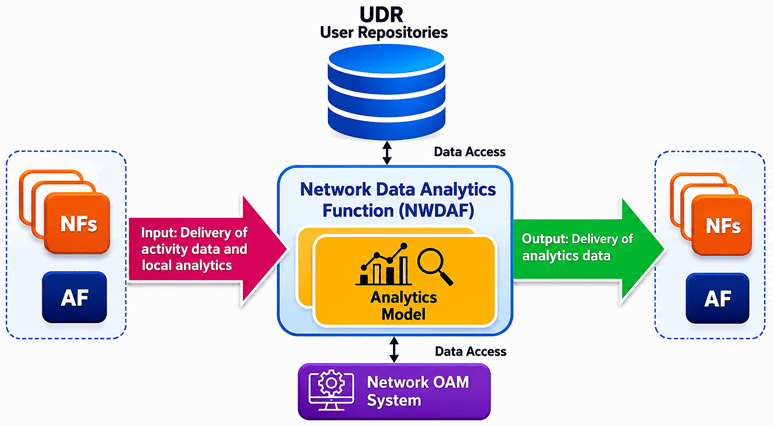
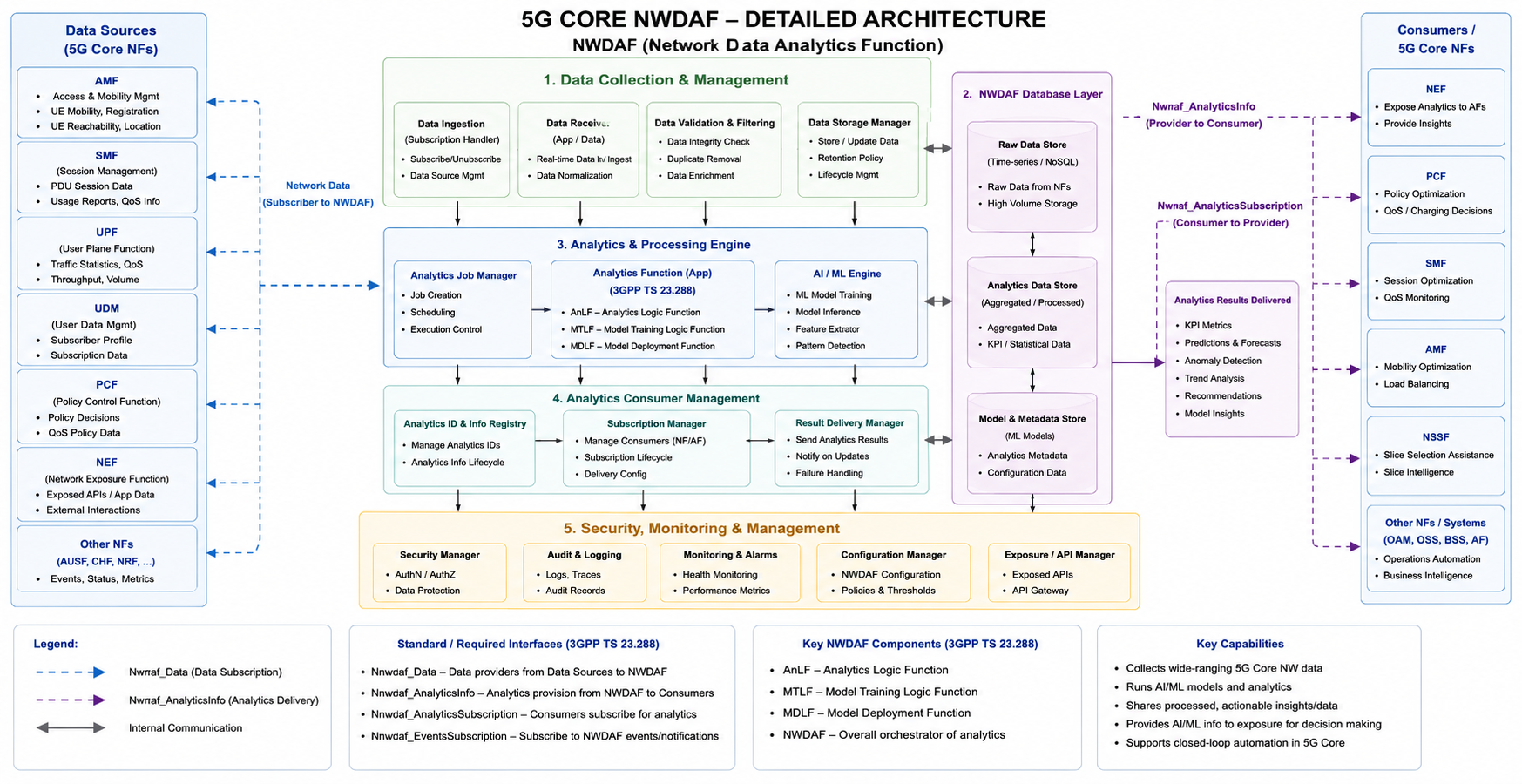
Fig: High-level NiralOS NWDAF architecture showing data collection, analytics processing, and analytics delivery across the 5G Core.
What is NiralOS NWDAF?
NWDAF, or Network Data Analytics Function, is the analytics engine of the 5G Core. In simple terms, it collects data from different 5G Core functions, processes that data, and shares useful insights with the parts of the network that need to make decisions.
In NiralOS, NWDAF is designed to act as a standardized analytics service. It supports event-based analytics, periodic reporting, operational alarms, and triggers for external systems such as edge orchestration platforms. While the platform supports the broader workflow needed for AI and ML-driven analytics, agentic AI implementation is currently outside the implemented scope.
Why NWDAF Matters in 5G
A modern 5G network cannot rely only on static policies and manual intervention. Traffic patterns change quickly, user movement is dynamic, and application requirements differ from one slice or service to another. NWDAF helps the network move from reactive operations to data-driven, closed-loop intelligence.
Its significance in the 5G architecture comes from five major roles:
- It provides analytics services to other network functions through event subscriptions and periodic notifications.
- It collects UE connection and mobility information from the AMF.
- It gathers PDU session and user plane characteristics from the SMF and related traffic context from the core.
- It feeds analytics into policy-related decisions, including inputs that can help the PCF act more intelligently.
- It can expose analytics to third-party applications, including edge orchestration systems and future AI-driven applications, through network exposure mechanisms.
In short, NWDAF helps transform network data into operational decisions that improve service quality, scalability, and user experience.
Core Capabilities in NiralOS NWDAF
NiralOS NWDAF implements several practical analytics capabilities that directly support 5G Core operations. These functions are designed to make the network more aware, adaptive, and efficient.
1. Congestion Detection on Network Slices
NiralOS NWDAF can detect congestion on a network slice based on the number of connected UEs or based on aggregated uplink and downlink traffic crossing a defined threshold. For example, the system can report congestion when 100 UEs are connected to a slice, or when combined UL and DL traffic exceeds a configured limit.
This is important because slice-level congestion directly affects service quality. By identifying load build-up early, operators can trigger corrective actions such as traffic redistribution, scaling decisions, or policy adjustments.
2. UE Mobility Behaviour and Traffic Pattern Analytics
User movement and traffic behaviour are critical in mobile networks. NiralOS NWDAF analyzes UE mobility patterns and communication trends to help the core understand how users move, where demand shifts, and which applications are generating traffic.
These insights can support smarter UPF selection, better traffic steering, and lower latency for mobile users. This becomes especially valuable for enterprise use cases, video applications, and latency-sensitive services.
3. 5G Core Scalability and Load Balancing Support
A major operational use case for NWDAF is helping the 5G Core scale intelligently. NiralOS NWDAF can provide analytics that support decisions such as instantiating additional UPFs when traffic increases, allowing the network to handle growing demand more effectively.
This improves resource efficiency and service continuity. Instead of waiting for performance degradation, the network can take action based on analytics and predicted load conditions.
4. Traffic Anomaly Detection
NiralOS NWDAF can detect unusual traffic behaviour across the network. This includes identifying abnormal traffic bursts, unusual signalling behaviour, or patterns that may indicate faults, misconfigurations, or service risks.
Anomaly detection is essential for service assurance. It helps operators identify problems earlier, reduce troubleshooting time, and protect network quality before users are impacted.
- Analytics request/response: A consumer NF sends a analytics request to NWDAF and receives an analytics output. This is useful when a network function needs a one-time insight for an immediate decision.
- Analytics subscription/notification: A consumer NF subscribes to analytics updates from NWDAF and receives notifications over time. This is useful for continuous monitoring and closed-loop automation.
- Data collection: NWDAF gathers data from multiple sources such as AMF for UE information, SMF for session data, UPF for traffic and packet behaviour, NSSF for slice context, as well as OAM, NEF, and other network elements.
This service model makes NWDAF a central analytics hub rather than just a reporting function. It connects data collection, processing, and decision support in one standardized framework.
Click Image to Enlarge
Fig: Simplified NWDAF data flow showing how network functions provide input data and how analytics outputs are consumed by other functions and applications.
Important Analytics Use Cases
The strength of NWDAF lies in how its analytics can be applied across network operations. NiralOS NWDAF supports several high-value use cases for operators and enterprise 5G environments.
Network Slice Load Analytics
NWDAF monitors the load on each active network slice and provides visibility into slice usage levels. This can improve slice selection, capacity planning, and load balancing across services.
UE Mobility Analytics
By studying how users move across the network, NWDAF can help optimize mobility handling and guide better UPF placement or selection. This can reduce latency and improve application performance.
UE Communication Analytics
NWDAF can profile traffic behavior for different devices and services, including low-latency applications and video streaming. This helps the network understand service demand and optimize treatment accordingly.
QoS Sustainability Prediction
NWDAF can support better quality-of-service decisions by analyzing whether current service levels can be sustained. This helps improve service assurance and maintain experience consistency.
Abnormal Behaviour Detection
NWDAF can identify unusual signaling activity, abnormal traffic patterns, and other indicators of network issues. This strengthens fault detection and operational responsiveness.
Load Balancing and UPF Selection
NWDAF analytics can help the SMF choose the most suitable UPF based on load and performance conditions. This improves session handling and overall user plane efficiency.
NWDAF and AI/ML
NWDAF is highly relevant in the journey toward intelligent and autonomous networks. In NiralOS, it provides a strong and standardized analytics workflow that can work with statistical methods, machine learning models, prediction algorithms, time-series analysis, and traffic classification techniques.
This is important because operators do not always need to build everything from scratch. NWDAF provides the structure for collecting data, organizing analytics workflows, and integrating with external AI or LLM-based systems where needed.
From a practical standpoint, NWDAF acts as the operational bridge between raw network telemetry and higher-level intelligence. It creates the foundation for future-ready use cases, including advanced automation, smarter orchestration, and AI-assisted service assurance.
Role in Edge Orchestration and Future Automation
One of the most important outcomes of NWDAF is that analytics do not stay isolated within the core. They can be exposed to external systems through network exposure capabilities, allowing orchestration layers and third-party applications to use them for decision-making.
For example, when slice congestion rises or traffic patterns change, NWDAF insights can trigger edge orchestration actions for dynamic scalability. This makes the network more adaptive and helps align infrastructure capacity with real-time service demand.
NiralOS NWDAF is more than an analytics module inside the 5G Core. It is a decision-support engine that helps operators understand network conditions, detect congestion and anomalies, optimize mobility and UPF selection, and build the foundation for closed-loop automation.
As 5G networks continue to support more enterprise, edge, and mission-critical services, analytics-driven intelligence becomes essential. NiralOS NWDAF delivers that intelligence through a standardized, practical, and deployment-ready framework built for real-world 5G operations.

