


Abstract
TSN is increasingly important to industrial automation, automotive networks, energy systems, professional audio/video, robotics, transportation, and other cyber-physical systems.
The emergence of private 5G networks extends this deterministic-networking concept into the wireless domain. 3GPP introduced TSN integration capabilities in Release 16 and enhanced them in Release 17, enabling a 5G System to participate in an Ethernet TSN environment as a logical or virtual TSN bridge. This architecture allows industrial applications to combine the deterministic behavior of TSN with the mobility, flexibility, and cable reduction provided by 5G.
NiralOS implementation of TSN, addresses network architecture, traffic scheduling, reliability model, synchronization framework, configuration approaches, and integration with NiralOS 5G. It also examines TSN-to-5G QoS handling, industrial deployment scenarios, implementation challenges, and the expected evolution of deterministic communications.
Executive Summary
Industry is increasingly dependent on networks not merely to transport information, but to control physical processes.
A conventional enterprise network can tolerate an occasional variation of several milliseconds in packet delivery. An industrial motion-control application may not. Ethernet communications are not deterministic because only one frame can normally occupy the transmission medium at a given instant. The second frame must wait. Its waiting time depends on factors such as: the length of the frame already being transmitted, queue occupancy, traffic priority, congestion, switch architecture and traffic generated by other devices.
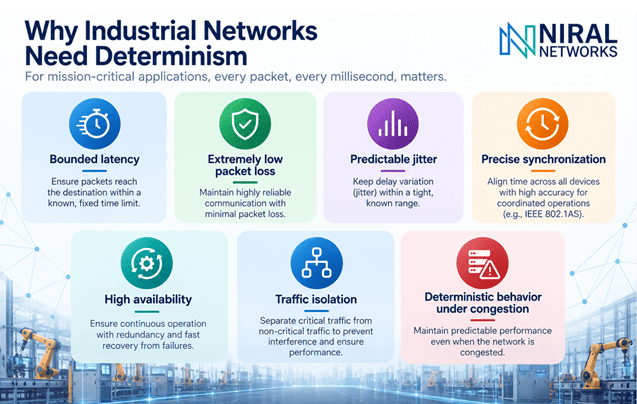
For a robotic arm, power protection system, autonomous vehicle, synchronized production line, or precision motion-control system, communications must often satisfy several simultaneous requirements:
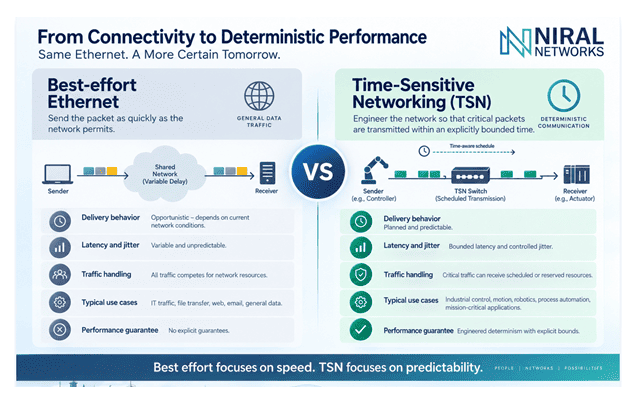
The following diagram illustrates the key difference between Ethernet based communication and TSN architecture/infrastructure:
A deterministic network could, for example:
- synchronize all bridges to a common time base;
- reserve resources for a robotic-control stream;
- schedule that stream for a specific transmission window;
- interrupt a lower-priority frame when required;
- replicate critical frames across two independent network paths;
The significance becomes greater when TSN is integrated with NiralOS 5G.
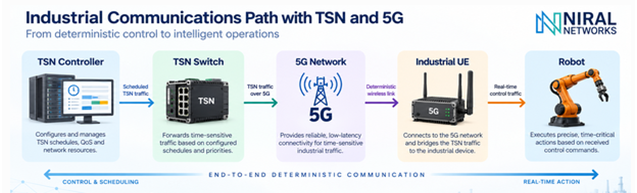
3GPP’s 5G-TSN architecture allows a 5G System to be represented toward an external TSN network as a TSN-compatible virtual bridge. Functions known as the Device-Side TSN Translator and Network-Side TSN Translator provide the integration points between the 5G system and the external TSN domain. A TSN Application Function supports interaction between 5G policy mechanisms and the TSN control environment.
The long-term importance of TSN is therefore not simply faster Ethernet. It is the creation of a common deterministic communication framework capable of spanning wired Ethernet, industrial systems, 5G, and potentially deterministic IP networks.
TSN Architectural
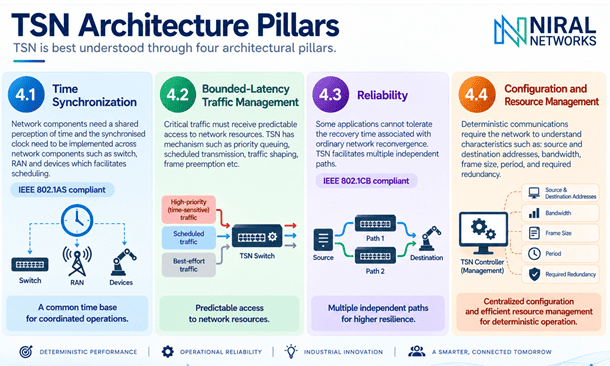
TSN is best understood through four architectural pillars. The following diagram illustrates the four pillars of TSN:
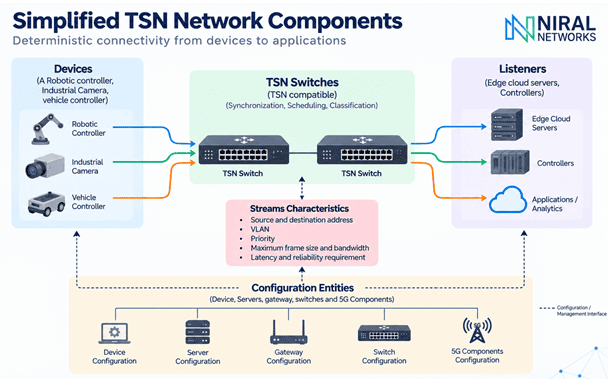
The following diagram illustrates a simplified TSN network components with standard devices and equipments used in a TSN network:
Why Integrate TSN with 5G?
Combining TSN and 5G therefore offers a compelling architecture:
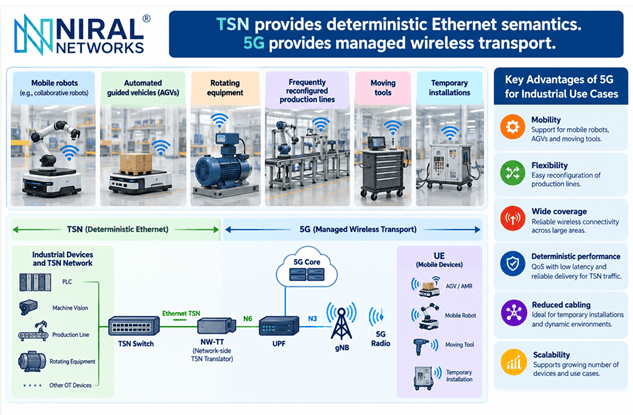
TSN provides deterministic Ethernet semantics. 5G provides managed wireless transport and at the same time retaining the characteristics of the TSN stream when they pass through.
The following diagram captures scenarios to use 5G and TSN as well as the advantages provided by private 5G networks:
5G TSN Translation and Application Functions
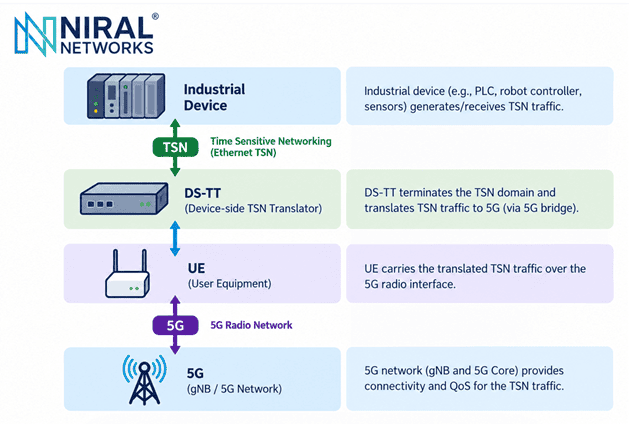
Device-Side TSN Translator — DS-TT
The DS-TT is associated with the device/UE side. It provides translation between the external TSN environment and the 5G communication system. The following diagram depicts the same.
Network-Side TSN Translator — NW-TT
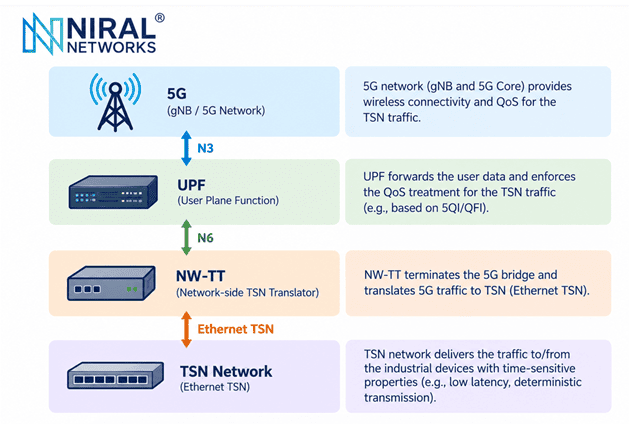
The NW-TT is associated with the network side, typically in relation to the UPF. Together, NW-TT and DS-TT form the logical TSN-facing boundaries of the 5G bridge. The following diagram depicts the same.
TSN Application Function
The 5G control architecture requires a mechanism capable of interacting with external TSN management and control information. The TSN AF assists in exposing 5G bridge-related information toward the TSN environment and translating TSN communication requirements into information usable by 5G policy and session management functions.
5G-ACIA describes how TSN traffic QoS information can be received through TSN control interaction and mapped into appropriate 5G QoS treatment.
TSN Stream to 5G QoS Flow
One of the most important practical questions is: How does an Ethernet TSN stream become deterministic traffic inside a 5G network? The following diagram explains the mapping between TSN streams and 5G data path supported by 5G control path.
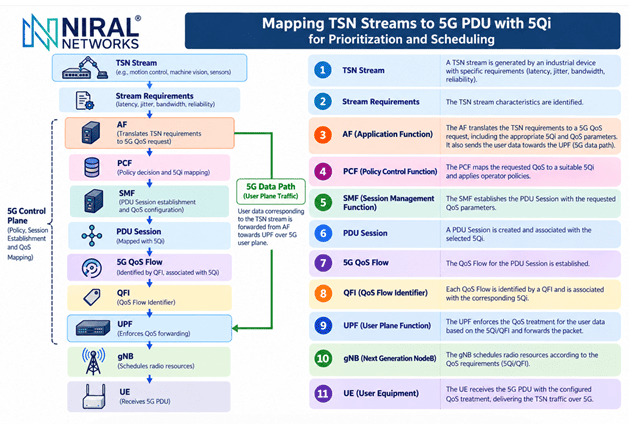
The external TSN network describes the communication requirements. The 5G control plane translates these requirements into appropriate policy and QoS configuration.The traffic can then be associated with a QoS Flow inside a PDU Session. Each QoS Flow has a QoS Flow Identifier, or QFI.
5G QoS and Deterministic Communications
5G provides a QoS framework in which traffic can be separated into QoS flows. The deterministic nature is derived from the combination of the following concepts:
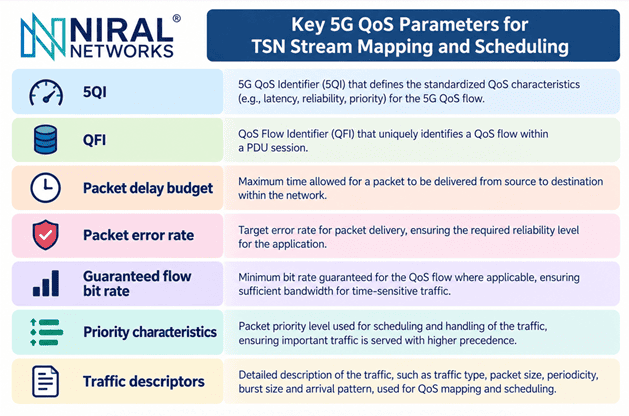
For deterministic communications, the system needs additional awareness of traffic timing characteristics. The mobile network can use such timing awareness to allocate resources more intelligently. The objective is not simply to prioritize the packet after it arrives. The preferable approach is to anticipate when deterministic traffic will arrive and ensure the required communication resources are available.
TSN and 5G Industrial Use Cases
The industrical automation is one of the key application of TSN and the requirements can be categorised as per the following table:
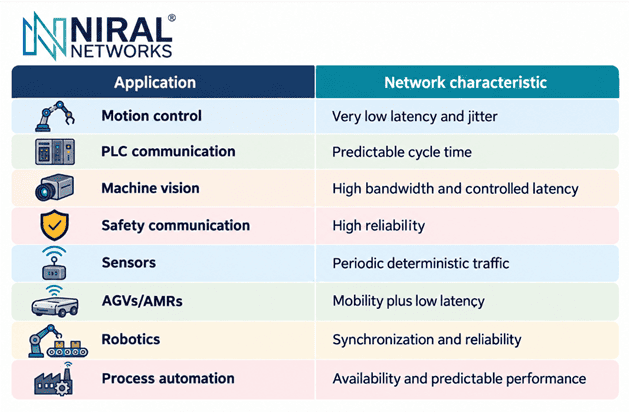
Historically, different industrial Ethernet protocols implemented deterministic behavior through vendor-specific mechanisms. 5G network faciilitates TSN-enabled Ethernet frames while TSN provides deterministic network transport. Let us look at some key use cases in a typical indistrial setup.
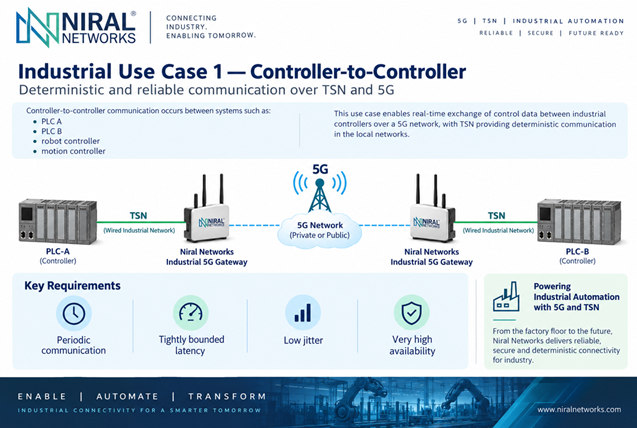
Use Case 1 — Controller-to-Controller
In a typical industrial test setup Controller-to-controller communication occurs between systems such as two PLC say controlling a robot controller and motion controller. The key requirement here is high availability of the network along with tight bound latency/low jitter. The following diagram depicts the scenario:
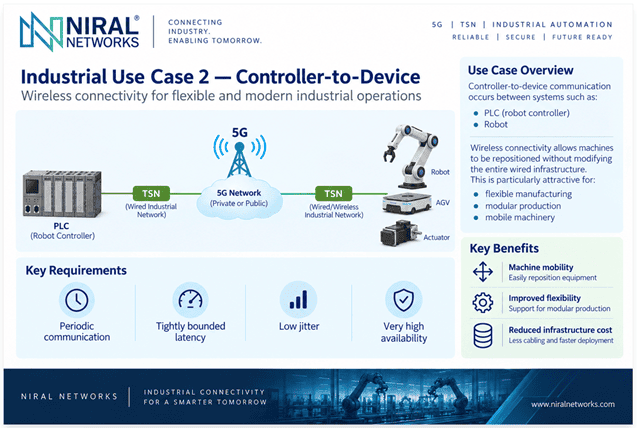
Use Case 2 — Controller-to-Device
In a typical industrial test setup Controller-to-device communication occurs between systems such as a PLC say controlling a robot controller and a robot. The key requirement here is high availability of the network along with tight bound latency/low jitter. The following diagram depicts the scenario:
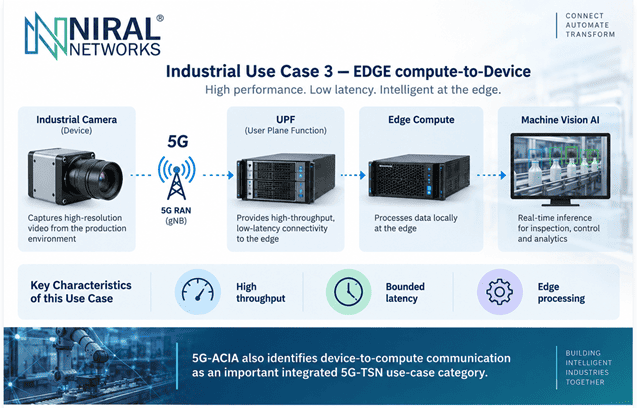
Use Case 3 — Device-to-Compute
In a typical industrial test setup device-to-edge compute communication occurs between systems such as a Video analytics server analysing video streams from industrial camera. The key requirement here is high availability of the network, edge processing along with tight bound latency/low jitter. The following diagram depicts the scenario:
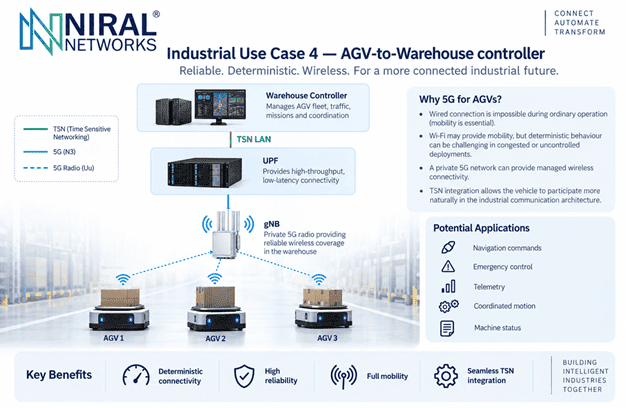
Use Case 4 — Automated Guided Vehicles
In a typical industrial test setup AGV-to-controller communication occurs between systems such as a AGV controller and a AGV device. The key requirement here is deterministic connectivity of the network, full mobility and seamless TSN integration. The following diagram depicts the scenario:
Deployment Challenges
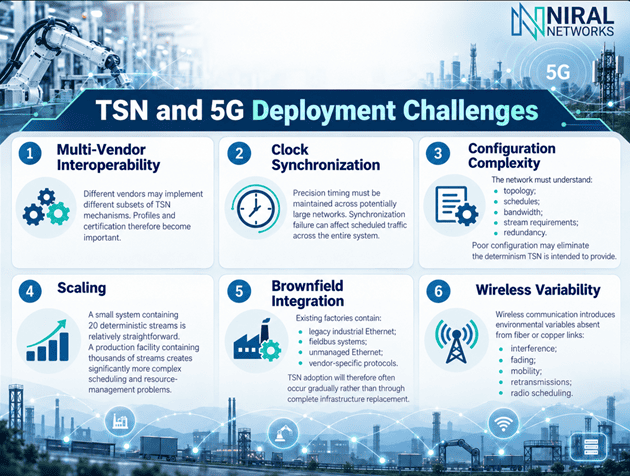
Although TSN offers major benefits, deployment is not trivial. The challenges range from scalability, multi vendor equipment integration, legacy system integration to name a few. The following diagram illustrates the deployment changes in deploying TSN in the context of 5G network.
Conclusion
Time-Sensitive Networking represents a fundamental evolution of Ethernet. Traditional Ethernet was optimized primarily for interoperability, throughput, simplicity, and statistical multiplexing. TSN extends Ethernet so that critical traffic can also receive predictable behavior.
The key concept is therefore not simply prioritization. It is determinism. A high-priority packet is not necessarily deterministic. A deterministic packet is one for which the network has been engineered to provide an explicit and predictable service.
The combination of TSN and 5G significantly expands this concept. 3GPP Release 16 introduced standardized support for integration with TSN, with Release 17 providing further enhancements. In an integrated architecture, the 5G System can be represented to the external TSN network as a logical TSN bridge.
The longer-term architecture therefore points toward convergence of TSN, 5G, and Edge computing. Rather than operating separate networks for motion control, industrial automation, video, enterprise traffic, mobile robots, and edge computing, organizations may increasingly operate common infrastructures capable of providing multiple deterministic service levels.
The transition will not happen immediately. Challenges remain around configuration, interoperability, synchronization, wireless variability, cloud infrastructure, brownfield integration, and certification. Industrial efforts are consequently important for establishing consistent interoperable behavior, and the standardization work continues to evolve.
